
Please familiarize yourself with the École George Elliot Secondary Code of Conduct and supporting documents.
École George Elliot Secondary Code of Conduct
Using Your Phone at George Elliot
Updated August 2026
École George Elliot Secondary Code of Conduct
Who Does This Code of Conduct Apply to?
The Code of Conduct applies to all students:
- on school property or off property while travelling to and from school while on breaks
- in attendance at school or any school-sponsored activity
- whose behaviour at any time or place, including online, has a negative effect on the school environment and/or learning
BC Human Rights Code
École George Elliot Secondary School promotes the values expressed in the BC Human Rights Code (see Board Policy 4050, 4060) respecting the rights of all individuals in accordance with the law. All participants in school business, activities or events shall conduct themselves in a manner that does not contravene these rights and its basic principles of respect and fairness. No person shall discriminate against another based on race, colour, ancestry, place of origin, religion, marital status, physical and mental disability, gender, gender identity and expression or sexual orientation within the school environment or through the school system and its related function through publication, or in accommodation, service or facility. The school will treat seriously any behavior that contravenes the grounds set out in the BC Human Rights Code.
Rights and Responsibilities
Rights | Responsibilities |
Students have the right to work and learn in an environment conducive to a quality education. | Students have the responsibility to actively participate and to be responsible learners. Some examples include but are not limited to:
|
Students have the right to be treated with respect. | Students have the responsibility to respect others (not to bully, tease, pick on, or harass others). Some examples include but are not limited to:
|
Students have a right to privacy and security of personal space. | Students have the responsibility to respect the property and privacy of others (learners, staff and community). Some examples include but are not limited to:
taking and sharing digital images and/or videos respectfully and with proper permission only |
Students have the right to feel safe at school. | Students have the responsibility to behave in a safe manner and to protect the safety of others. Some examples include but are not limited to:
take an active role in ensuring the safety of all members of the school community |
Academic Integrity
At École George Elliot Secondary School (GESS), academic integrity supports our commitment to a safe, caring, and orderly learning environment where all students can succeed. Academic integrity reflects the values of honesty, responsibility, and respect, and ensures that assessment accurately reflects student learning.
Academic integrity is demonstrated when students:
- Are honest and submit work that is of their own learning and thinking
- Are honest and acknowledge the ideas and contributions of others
- Are responsible and complete assessments independently unless otherwise directed
- Are responsible and use technology and AI tools appropriately and as permitted by the teacher
- Are respectful and do not interfere with the learning of others
Academic dishonesty occurs when a student misrepresents their learning. This includes, but is not limited to:
- Copying or submitting another person’s work as one’s own
- Paraphrasing or reorganizing content without proper acknowledgment
- Sharing or distributing assignments, tests, or answers without permission
- Accessing or using unauthorized materials during assessments
- Falsifying or fabricating information, data, or sources
- Using digital tools, translators, or AI in ways that misrepresent understanding
Examples of Academic Dishonesty include:
- Copying homework, assignments, or lab work from another student
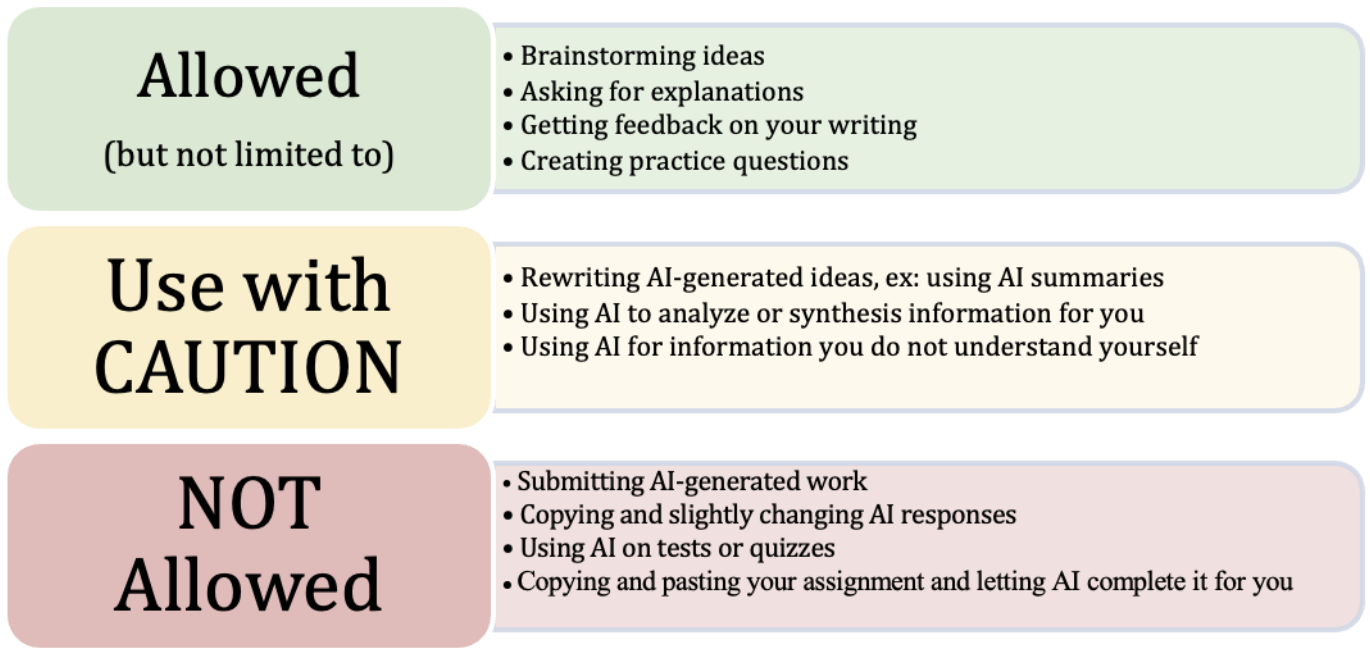
- Submitting AI-generated work as your own
- Using translation tools to produce work beyond your understanding
- Sharing test or quiz answers with others
- Using unauthorized notes or devices during assessments
- Failing to cite sources when using ideas, images, or text
- Altering or fabricating data in labs or assignments
Responsible Use of AI and Digital Tools
Students must use digital technologies in a way that supports learning and reflects academic integrity. Whenever in doubt, seek guidance from your teacher about approved AI and digital tools, verifying the accuracy of AI-generated information, protecting personal information, and avoiding the spread of misinformation. Inappropriate use of AI, including submitting AI-generated work as one’s own, constitutes academic dishonesty. Students are responsible for demonstrating honesty in their work, completing assignments with ownership and agency,, respecting the learning environment, and seeking clarification from their teacher when unsure about expectations.
AI Use Continuum - Is this Work Your Thinking and Learning?
Consequences for Academic Dishonesty
Consequences for academic dishonesty should be educational, appropriate, and proportional.
First or Minor Incidents | Significant or Repeated Incidents |
|
|
Attendance
Success is directly related to students' work ethic and active participation in classroom learning. Parent/guardian support of regular, on-time attendance is paramount to the academic success of their child. Each absence results in a lost learning opportunity in the classroom that may not be recreated. Regular attendance and punctuality is necessary for students to gain the full benefit of educational instruction. Absenteeism may result in loss of course credit.
If a parent/guardian determines that the student must be absent from school, the parent/guardian needs to inform the school prior to the scheduled time for that class. Parents/guardians are asked to notify the school of any extended absences well in advance when possible. Please note that optional extended absences (such as long family vacations during the school year) may not be able to be academically supported; GESS does not offer "distance learning" through Google Classroom substituting for in-class, in-person learning.
In the case of a long-term illness a doctor's note may be requested. Please consult with your child’s vice-principal in such cases.
Bicycles, Scooter and Skateboards
Bicycles, scooters, and skateboards are an effective, healthy means of transportation to and from school. We encourage their use as transportation, however, we cannot take responsibility for lost, stolen or damaged equipment. We also encourage students to wear helmets while using bicycles, scooters and skateboards and ask that parents/guardians please have a discussion with your child about traffic safety. Bicycles, scooters and skateboards are not to be used on any part of GESS property. These items are not to be brought into classrooms.
Scooters and bikes should be secured with a good lock in the racks located at the front of the school. Skateboards should be stored securely in lockers. We do not have alternative storage inside the building for bikes, scooters, or skateboards (not in classrooms, not in storage rooms, not carried from room to room throughout the day). These places are not necessarily secure, and we know that these items are costly for families to replace ‐ however, the school cannot be held responsible for lost, misplaced, or stolen property stored in various unsecured areas around the school.
A Special Note about E-Bikes, E-Scooters, and E-Motorbikes
According to British Columbia's Motor Assisted Cycle (E-Bike) Regulation, there are specific age limits and safety requirements for operating e-bikes and e-scooters on public roads. Here are the key points:
- Standard E-Bikes: Riders must be at least 16 years old
- https://www2.gov.bc.ca/gov/content/transportation/driving-and-cycling/cycling/cycling-regulations-restrictions-rules/e-bikes
- Light E-Bikes: Riders must be at least 14 years old
- E-Scooters (stand-on-top): Riders must be at least 16 years old https://www2.gov.bc.ca/gov/content/transportation/driving-and-cycling/cycling/electric-kick-scooter-rules
- E-Motorbikes are not permitted on public roads in BC and should not be brought to school.
Students and their families must ensure that students are of legal age to ride E-bikes or E-scooters. To assist students and families with this item in the code of conduct, we are providing this Know the Rules Before You Ride Infographic from the RCMP. Students and members of the public in violation of the Motor Vehicle Act can be referred to the RCMP.
Central Okanagan Public Schools Appeal Policy 3090
Parents and guardians of a learner who is entitled to an educational program in Central Okanagan Public Schools may appeal the decision of an employee of the Board of Education which significantly affects the education, health or safety of the learner.
- STEP 1: Parent meets with employee (ie. teacher)
- STEP 2: Parent meets with principal
- STEP 3: Parent meets with the Superintendent or designate (ie. Lake Country Family Assistant Superintendent)
If at this point the issue remains unsolved and the parent/guardian is not satisfied, the parent/guardian has a right to a final appeal to the Board. This district policy is in place to help ensure that effective communication is part of the problem-solving process. Details of this process are available at the school and on the District website (Board Policy 3090).
Dress Code
George Elliot is committed to providing students with learning environments that are safe, responsive, and inclusive. We recognize that decisions about dress reflect individual expression of identity, socio-cultural norms, and that they are personal.
Students may attend school and school-related functions in dress of their choice provided that their choices:
- Conform with established health and safety requirements for the intended activity
- Do not represent or promote alcohol or drugs
- Use respectful language
- Do not depict or promote violence, racism, sexism or discrimination
- Are not intimidating to others
Ultimately, the school administration has the responsibility to apply the dress guidelines when necessary. If any learner dresses in an inappropriate manner, the individual will be advised personally and discretely and given an opportunity to meet school district guidelines.
Footwear must always be worn for health and safety reasons.
Our School Community Neighbours
Members of our school community are expected to conduct themselves in a responsible manner. There is an expectation that the businesses, families and properties located in the school neighborhood are treated respectfully. Anyone who engages in conduct which disturbs, disrupts or damages the persons or property of the school neighborhood may be subject to school discipline and/or legal consequences.
Personal Property/Lockers
At the beginning of the year, all learners will be offered a school lock and locker if they would like one. All locks and lockers remain the property of the school and the school retains access to the lockers throughout the year. Lockers may be opened and searched when school administration deems it necessary. Personal locks are not to be used for safety and security reasons.
Students should not bring unnecessary items, valuables, or large amounts of money to school. The school cannot be responsible for lost or stolen items. Students are urged to safeguard their valuables/backpacks/property by storing items in their lockers. Items of value should never be left unlocked in the gym change rooms.
In order to ensure student's belongings are safe, lock combinations and lockers should not be shared.
A replacement fee of $5.00 may be charged to students who have lost their locks.
Signing In/Out
Students coming late to school are required to sign in at the office. Students who need to leave school during instructional time must inform the teacher and sign out at the office. Students will be asked to provide a note from a parent/guardian or have a staff member speak to a parent/guardian on the phone when signing out. When students are signed out by parents/guardians during the instructional day, students are under the care of their parents/guardians and are required to leave the school property for supervisory reasons.
School Visitors
All visitors to the school must report directly to the office and state their reason for visiting the school. Visitors may not be in the halls unsupervised without express permission from the school administration for safety reasons. Students are required to make prior arrangements to meet their friends who do not attend George Elliot off the school property after school hours.
Learners from other schools are not permitted to be on George Elliot property during the school day, just as George Elliot students are not to be on other school properties during the school day.
We do not allow friends or family (ie. siblings or cousins) of students to "visit for the day" and attend classes with learners. This practice is disruptive to learning environments and becomes a supervision issue.
Technology Use
Responsible Student Use of Personal Digital Devices, School Technology, and District Network Services
Student use of personal digital devices (any device used to communicate and/or access the internet), school technology, and district networks at school is for educational purposes.
Students must abide by the school’s Code of Conduct and procedures, as well as Central Okanagan Public Schools Policy 486: Student Use of Network Services and Digital Technologies.
Students will:
- Secure, power off and store personal digital devices during instructional time (i.e. class time) at Secondary Schools unless instructed by the Principal or school staff;
- Use personal digital devices during instructional time for instructional purposes and digital literacy skills as instructed by the Principal or school staff;
- Ensure personal digital devices are not used in areas where privacy is expected, such as restrooms and change rooms;
- Be permitted to use personal digital devices to support accessibility, accommodations, medical and health needs;
- Always take precautions to ensure online safety, privacy, and security;
- Treat others with respect and kindness when using digital devices and district network services;
- Always use digital devices and district network services responsibly and with academic integrity.
Using Your Phone at George Elliot
To support families, staff, and student learning of this item of the code of conduct, we have provided a Using Your Phone at George Elliot infographic. We encourage families to follow the link and review this infographic with their children.
Schools will ensure that all students have equitable and developmentally appropriate access to technology to meet curricular requirements. Students are not required to have their own personal digital device or cellphone at school.
The use of personal digital devices, school technology, and district networks is a privilege. Staff may revoke a student’s access to devices because of inappropriate student conduct.
Violations of the school code of conduct could result in appropriate restorative processes or disciplinary actions including suspension and police intervention.
Student Drivers
All student drivers will be required to meet with the administration to have a conversation about parking expectations prior to registering for a parking pass.
Under no circumstance are students allowed to drive other students on school sponsored activities. Students driving to and/or from school sponsored activities must complete a driver declaration form prior to the activity.
Students who drive recklessly or demonstrate unsafe behaviour on George Elliot property may face suspension and/or lose the right to bring vehicles to school. The RCMP will be contacted in serious situations. Students may park in the school's parking lot in the designated student parking area. Illegal parking may result in tickets and/or towing. In the interest of safety, students are encouraged to not unnecessarily loiter in the parking lot.
Vaping, Smoking and Use of Tobacco Products
In accordance with Provincial regulations, all schools in Central Okanagan Public Schools are designated as smoke free areas (Board Policy 640). Any member of our school community who chooses to use tobacco products or vape, must do so off school property. Students using tobacco or vape products on school property will have them confiscated. Please note that the District of Lake Country has a bylaw (Bylaw 954) that prohibits smoking or vaping in public places.
School Search and Seizure Policy
Student searches may be made based on reasonable suspicions of a violation of school rules and/or law. The search shall be made pursuant to the reasonableness, under all circumstances, of the search. The search of a student shall be justified at its inception, based on reasonable suspicion and reasonable scope considering the age of the student and the nature of the infraction. Contraband and other property unauthorized to be on school property or school sponsored activities will be seized for evidentiary purposes in a school hearing and/or legal hearing. Return of the property may be made to the parents/guardians of the student. Illegal substances or property will be turned over to law enforcement.
Violations of the Code of Conduct
We recognize that the vast majority of members of our school community conduct themselves in a positive and responsible manner. However, violations of this Code of Conduct will occur, some being minor and some being more serious, and therefore will be dealt with accordingly.
Discipline is governed by District Policies 455 and 455R. Students may be disciplined for violations which occur going to and from school, off school property (and outside of regular school hours), if such violations adversely affect students or the operation of any school.
Examples of unacceptable conduct that would constitute violations of the Code of Conduct include (these examples cited do not comprise an all-inclusive list):
Behaviours that:
- interfere with the rights of others to learn (e.g. getting into a power struggle with another school member or members)
- create an unsafe situation for any school member (e.g. not complying with safety procedures when working with equipment)
- distract others from focusing on instruction or concentrating on prescribed tasks.
- are willfully disobedient
- are repeated violations of the code of conduct (ie: smoking, vaping, substance abuse, truancy, inappropriate language, etc.)
Acts of:
- bullying, harassment or intimidation - including those by electronic means
- truancy or failure to apply oneself to their studies
- physical violence, vandalism, or assault
- retribution against a person who has reported incidents
- discrimination or similar acts as defined by the BC Human Rights Code
Illegal acts, such as:
- possession, use or distribution of illegal or restricted substances
- possession or use of weapons
- bomb threats
Discipline Procedures
In the event of a violation of our Code of Conduct, the staff will endeavor to act consistently by:
- communicating with all individuals involved
- determining all the facts
- dealing with students with fairness and respect
We understand that students require assistance in their development and in subscribing to these socially responsible values and behaviours. One role of school staff is to educate and guide our learner’s social development by increasing expectations and consequences as students mature both physically and socially. As a result, responses to behaviour will vary according to these variables. Generally, as a student matures, expectations will increase, and consequences will be adjusted accordingly.
We recognize that each incident must be dealt with on an individual basis, dependent upon severity, circumstance, and history. Every effort will be made to suit the consequence to the learner and the situation using a progressive disciplinary model as per district policy. Whenever possible, the learner, with the assistance of the administrator, teacher, behaviour intervention teacher, counselor, and/or parent/guardian, will be involved in addressing the concern. Where appropriate, special considerations may apply to learners with special needs who violate the Code of Conduct in a manner that reflects their intellectual, physical, sensory, emotional, or behavioural abilities.
Consequences for violations of the Code of Conduct are designed to reinforce positive behaviours and encourage positive change for those involved. Consequences may include discussions with school staff, mediation, restitution, community service, loss of personal time and/or suspension. Due to legal confidentiality reasons, school and district staff cannot disclose confidential information related to a child's disciplinary details or consequences to anyone other than the legal guardian of the child. The use of consequences will be governed by the following principles:
Consequences will:
- be appropriate to the student's stage of development
- reflect the intensity, frequency and/or duration of the inappropriate behaviour
- make sense to the student as much as possible
Minor violations of the school’s Code of Conduct are dealt with in a variety of ways (collaborative problem solving, meetings, detentions, school/community service etc.) leading to the development of more positive behaviour, and allowing learners to make amends for their behaviour.
More serious violations may lead to a behavioural/counselling support, disciplinary work-station detention, behaviour contracts, definite/indefinite in/out of school suspension, a Restorative Justice referral and/or RCMP involvement. The following examples are of more serious violations. It should be noted that this is not a comprehensive list.
Example of a Major Offense | Example of a Serious Offense |
|
|
For serious breaches of the Code of Conduct, suspensions from school may be issued by an administrator. A suspension is the removal of a student's right to attend regularly scheduled instructional sessions. Suspensions may either be definite or indefinite:
- Definite suspensions, whether in-school or out of school, are suspensions up to and including ten school days
- Indefinite suspensions are those in excess of ten school days and are referred to the District Suspension Review Committee
Suspensions may have one or more of the following objectives:
- improve and/or correct student behaviour
- deter other students from similar behaviour
- plan proactive educational interventions
- clarify and solve problems
- protect the suspended student and/or other students/staff from dangerous behaviours
- provide or develop restorative justice opportunities